For beginners going to South Korea for cosmetic procedures, 90% of the problems stem from “choosing the wrong type of dermatology clinic.” This article clearly explains the key differences between the three main types of dermatology clinics in South Korea—streamlined services, one-on-one consultations, and specialized clinics—and provides guidance on who they are suitable for and how to avoid common mistakes. It also offers practical methods to help you make an informed choice and avoid unnecessary detours.
How to choose a dermatology clinic in South Korea without making mistakes? — The core criteria for selection.
There is no absolute good or bad among dermatology clinics in South Korea; the key lies in “matching your needs.” The three main types can be easily distinguished in one sentence. Beginners should remember this:
- Streamlined dermatology clinics: Focus on efficiency and affordability, offering standardized basic treatments. Suitable for beginners, those looking for short-term experiences, or those who want quick results.
- One-on-one dermatology clinics: Provide personalized treatment plans for precise improvements. Ideal for those seeking long-term solutions such as anti-aging, contouring, or sensitive skin treatment.
- Specialized dermatology clinics: Led by highly qualified doctors, focusing on safety and lasting results. Suitable for those with skin diseases or requiring more complex cosmetic procedures.
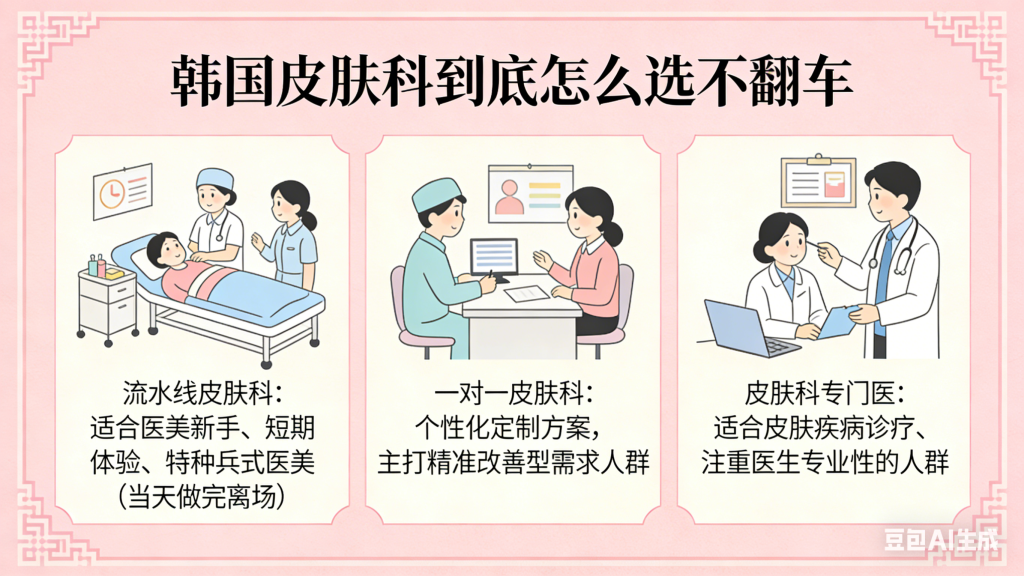
Essential information for beginners: A detailed breakdown of the three types of dermatology clinics in South Korea.
Many people complain that “cosmetic procedures in South Korea are not worth it” or “they don’t work,” but the real reason is often that they have chosen the wrong type of clinic. This section analyzes the characteristics, target audiences, advantages, and disadvantages of each type based on real scenarios to help you make the right choice.
(I) Streamlined dermatology clinics: Efficient and affordable, the perfect choice for beginners.
Core focus: “Standardized packages + fast turnaround.” These clinics offer basic cosmetic treatments, similar to “fast-food beauty services,” and are ideal for beginners looking for efficiency and value for money.
Real-scenario reproduction
Some sisters went to South Korea for medical beauty treatments for the first time with a clear goal in mind: picosecond freckle removal plus basic hydration treatments. They planned to complete everything on the same day and head back home immediately. They chose a chain-based dermatology clinic, and their experience was as follows:
- Waiting area: It was crowded and noisy. The waiting area was fully occupied, and patients had to wait for 1–2 hours without any dedicated staff to assist them.
- Consultation: The consultation was brief (within 5 minutes). The doctor did not ask in-depth questions about the skin condition but directly recommended a fixed package.
- Procedure: The process was carried out efficiently and quickly, with most of the work done by nurses while the doctor provided only basic guidance without any additional communication.
- Follow-up: There was no specialized post-treatment follow-up; only a general manual with post-treatment precautions was provided.
Key features & target audience
| Key features | Target audience | Advantages | Disadvantages |
|---|---|---|---|
| 1. Large chain scale with a wide range of services (mostly basic treatments); 2. Fast face- to-face consultations and quick procedures, serving over a hundred customers daily; 3. Transparent and affordable prices, with no hidden costs (be wary of low-price tactics to encourage additional purcha ses); 4. Mainly nurse-led services, with minimal doctor involvement. |
1. Beginners in cosmetic procedures who want to quickly try basic treatments (such as picosecond lasers, hydration, hair removal, etc.); 2. Those seeking efficient results with same-day visits; 3. People with limited budgets who only need short-term, basic improvements. |
High efficiency, low prices, and standardized processes, reducing the risk of major setbacks. | Lack of personalized plans, resulting in a subpar experience; minimal doctor involvement, making it unsuitable for complex needs; no dedicated follow-up after treatment. |
Key points to avoid pitfalls
Be cautious of “low-price tactics followed by forced additional purchases.” For example, a basic hydration treatment that originally costs 9,900 Korean won might have additional services recommended upon arrival. Ask in advance about what the package includes and refuse any last-minute additions.
(II) One-on-one dermatology: Personalized customization, the top choice for those looking for targeted improvements.
Core philosophy: “Diagnosis first, then customization,” focusing on precise results. Similar to a “cosmetic tailor-made service,” this approach is ideal for those with clear improvement goals and a high emphasis on the experience.
Real-life scenario reproduction
Another friend, who had loose skin and noticeable wrinkles, wanted to improve her anti-aging results but mistakenly chose a “streamline” dermatology clinic. After the treatment, she complained, “The plan itself wasn’t bad, but it just didn’t seem tailored to my needs; the results were mediocre.” Later, when she switched to a one-on-one dermatology service, the experience was completely different:
- Waiting area: Dedicated staff receive patients in separate waiting areas, so there’s no need to wait in long lines.
- Consultation: The consultation lasts for over 30 minutes. The doctor thoroughly examines the skin condition, lifestyle habits, and anti-aging goals, and even reviews past skincare routines to accurately identify the issues.
- Treatment: The doctor takes full control of the procedure, adjusting parameters based on the real-time condition of the skin. Nurses assist, ensuring smooth communication throughout the process.
- Follow-up: A dedicated consultant monitors the patient’s recovery after the treatment, provides regular reminders about skincare and follow-up appointments, and adjusts subsequent care plans accordingly.
Key features & target audience
| Key features | Suitable candidates | Advantages | Disadvantages |
|---|---|---|---|
| 1. Medium in scale, usually single-clinic operations with no focus on chain expansion; 2. Detailed in-pe rson consultations, with treatment plans tailored to individual skin conditions and needs; 3. Doctors play a leading role throughout the process, involving high levels of participation; 4. Exclusive post-treatment follow-up and emphasis on long-term management. |
1. Clear improvement goals (anti-aging, contour correction, sensitive skin repair, acne treatment, etc.); 2. F ocus on experience and effectiveness rather than quick results; 3.Wil ling to pay higher prices for personalized treatment plans. |
Accurate treatment plans that meet expectations; excellent c ustomer experience with high attention from doctors; po st-treatment support, suitable for long-term management. |
Prices are 30%-50% higher than those of mass-produced services; the process is mo re complicated and time-consuming, making them unsuitable for rapid medical aesthetics treatments. |
(III) Specialized dermatology clinics: Doctor-led, considered the safest and most effective option.
Core philosophy: “Doctor expertise first + precise diagnosis and treatment,” focusing on skin diseases and complex cosmetic procedures, similar to “expert clinics” for medical aesthetics, suitable for those who value safety and have specific needs.
Important note: Specialized doctors in Korea (red-tagged physicians) have high standards; they account for only 2% of dermatologists in the country, undergo rigorous training and certification, specialize in specific areas, and do not take on all types of projects blindly.
Core features & target audience
- Key characteristics
: 1. Doctors are at the center, and the clinic is named after the doctor or features their expertise; 2>
Doctors hold certifications from the Korean Dermatology Association or are red-tagged physicians, specializing in certain areas (e.g., skin diseases, advanced anti-
aging); 3>No standardized packages; treatment plans are customized based on individual
circumstances; 4>Emphasis on safety and careful procedures, without rushing for quick results; 5>Higher prices but long-term benefits promised. - Target audience: 1.
People with skin conditions such as severe sensitive skin, hormone-induced skin issues, or persistent a
cne; 2>Those seeking complex cosmetic procedures like detailed contour adjustments or scar repair; 3>Indivi
duals who value professional expertise and safe, long-lasting results; 4>Those requiring long-term skin care and willing to invest in higher-quality services. - Advantages and Disadvantages:
- Advantages include safety, professional expertise of doctors, and long-lasting results;
- Disadvantages include high costs, lengthy consultations and procedures, and a limited range of treatments (limited to areas where doctors have expertise).
For example, the Rukmeori Dermatology Clinic in South Korea is one of just 2% of dermatology clinics in the country to have received a red-label accreditation. The director, Choi Jae-won, comes from a three-generation medical family. We conducted an exclusive interview with him to provide you with more detailed information:
Exclusive Interview with Rukmeori Dermatology Clinic in South Korea
III. Frequently Asked Questions
Q1: Why is the experience and outcome so different among Korean dermatology clinics?
The main reason is a mismatch between customer needs and the type of clinic provided, rather than technical deficiencies. For example, if someone wants personalized anti-aging treatments but chooses a standardized clinic, the results will likely be less satisfactory.
Those looking for quick basic treatments may opt for specialized clinics that focus on precise, slow-paced care, only to find the results falling short of expectations.
Q2: Besides prices, what other key differences are there between standardized clinics and specialized ones?
Here are the 3 most important differences that beginners should remember:
- Different leaders: In a streamlined process, it is “nurses-led with doctor guidance,” while in a specialized medical approach, “doctors take full control”;
- Different logic: For streamlined processes, “projects are created first, and then suitable candidates are matched”; for specialized medical approaches, “patients’ specific needs are assessed first, and projects are designed accordingly”;
- Different focuses: Streamlined processes emphasize “efficiency and cost,” while specialized medical approaches prioritize “safety and long-term effectiveness.”
Q3: What are the most common mistakes beginners make when seeking cosmetic treatments in Korea?
By avoiding these 4 common pitfalls, you can save yourself 80% of unnecessary complications:
- Blindly following popular institutions: Relying solely on online reviews without considering the type of institution—for example, popular streamlined process centers are not suitable for long-term improvement;
- Confusing “one-on-one services” with “specialized medical care”: Thinking that one-on-one services are equivalent to specialized medical care; in fact, the former focuses on service quality, while the latter emphasizes the doctor’s qualifications;
- Focusing only on price and ignoring the doctor: Streamlined process centers may offer lower prices, but doctors often have less involvement, making complex procedures more risky;
- Not undergoing pre-treatment evaluations: Going straight to the clinic without understanding the type of institution or the doctor’s qualifications makes you vulnerable to being pressured into additional treatments.
IV. Beginner’s Practical Guide: 3 Steps to Quickly Find the Right Korean Dermatology Clinic
Don’t worry—follow these 3 steps, and even beginners can make an accurate choice and avoid common mistakes:
Step 1: Ask yourself these 3 questions to clarify your needs
- Do I want to “quickly try basic treatments,” or do I need “long-term skin improvement/anti-aging”? (Quick trials → batch services; long-term improvement → one-on-one consultations/specialists);
- Do I care more about “cost-effectiveness” or “the doctor’s expertise/personalized plans”? (Cost-effectiveness → batch services; expertise/personalization → one-on-one consultations/specialists);
- Am I more interested in “specific treatment options” or “finding a specialist doctor”? (Specific treatments → batch services/one-on-one; specialists → dedicated doctors).
Step 2: Use platforms to filter options and reduce information gaps
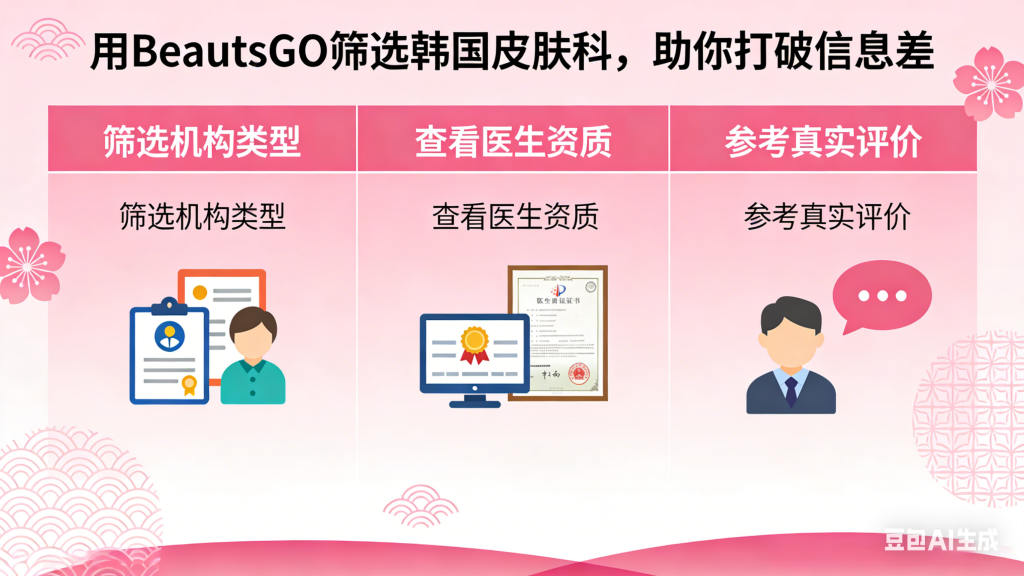
Beginners who are unsure about the types of clinics or doctors’ qualifications can use professional beauty screening platforms like BeautsGO. Here are 3 key things to do:
- Filter by clinic type: Clearly distinguish between batch services, one-on-one consultations, and specialized clinics to avoid mismatched options;
- Check doctors’ qualifications: Verify if specialized doctors have official certifications and whether their areas of expertise match your needs;
- Refer to real reviews: Check users’ actual in-person consultations and experiences to avoid fake recommendations from influencers.
Step 3: Confirm these 3 points before the procedure to avoid mistakes.
After selecting a suitable institution, make sure to confirm these 3 points before scheduling an in-person consultation:
- Confirm the leading doctor: Whether it is the doctor promoted by the institution and whether they will be in charge of the entire procedure.
- Confirm the type of treatment plan: Whether it is personalized customization or whether there are fixed packages that must be chosen.
- Confirm the price details: Check for any hidden costs or upselling tactics, and whether post-procedure follow-up services are included.
Summary
There is no absolute good or bad when it comes to dermatology clinics in Korea; it’s all about whether they suit your needs. When newcomers consider cosmetic treatments in Korea, they shouldn’t blindly follow influencers or compare prices. Instead, they should first understand the differences between mass-produced treatments, one-on-one consultations, and specialized medical services, and then match them with their own requirements and budget. This way, they can avoid unnecessary detours and get the best value for their money.
Remember: For quick results, choose mass-produced treatments; for personalized improvements, opt for one-on-one consultations; for safe and long-lasting results, seek specialized medical care. Once you understand this, all your doubts will be resolved.